Out-of-Class

In-Class

Experiencing Leadership
Encouraging new perspectives and different values
Mentorship is a topic for which I am overly gratful for and one in which I wish to pass on in the future. It has been through the advice of others that I have been so fortunate while at UofSC. As stated by Isaac Newton, "If I have seen further it is by standing on the shoulders of Giants." This website that I have constructed myself for example is based on the skills I learned in my first CSCE class: CSCE 102. This is where I created my first website with HTML and CSS. I wanted to carry on what I learned from Dr. Matthews and present how much I have grown since taking her class. It is from this foundation in understanding general coding that I was able to build into upper level classes, such as my current class CSCE 580: Artifical Intelligence which is filled with the fundamental algorithms practiced in prerequisites.
I demonstrate this growth in skill as a means to demonstrate the power of mentorship. I did not grow these skills myself but rather in collaboration
with my professors and peers. It has been through initiaitive, perseverence, and ambition that I practice these skills. I found that I grew more as I challenged myself further.
I was in Dr. Cole's Advanced Programming Techniques class when I heard that I should challenge myself to grow and broaden my skills in programming. I took this advice and
applied it in my class selections, choosing many classes which are considered "hard" by my peers, but also advantageous to my future goal of being a computational ecologists.
This lesson of challenging myself to grow doesn't just apply in academics, but life as well.
I mentioned before that I was diagnosed with T1D in my about me section. For me, it can be difficult to follow routine tasks, such as eating college meals.
Meals that are usually high in carbohydrates, such as instant noodles or pizza. It has been through the Office of Disabilities and my participation in Juvenile Diabetic Research
Foundation Research One Walks that I have been able to learn more proper meals for those with my condition. I have learned much from their mentorship on how to balance the busy life
of a college student and also as a college student with T1D. I often times experimented with new technologies, such as the recording pen or a new continuous glucose monitor.
It took time to take this advice given to me and shape it to something that worked for me. This lesson taught me to be patient and welcoming of new advice.
I was waiting to find a new project at UofSC when I saw an opening in the Senner lab to preform a mark and recapture study on a local SC
shorebird population in a little studied stopover site. I explained my interests of computational ecology and Dr. Senner offered me a much more appealing position.
He proposed a project to come up with a method to autonomously define shorebird behavior during the nesting period with only geolocator information in order to determine nesting success.
With this ability, the method would allow other research groups to evaluate the success of breeding populations of shorebirds and investigate without even having to
see the birds determine their breeding success. My Magellan proposal for the project can be seen below for more information. Th project was a once in a lifetiem opportunity,
but the most important experience for me was learnign from my graduate mentor, Luke Wilde.
Luke has been my right hand man on this project. Even though he is no longer a student at UofSC after transfering to pursue his PhD, he
has continued to be a supporting member to the project and myself. I did not have the knowledge to know the movement of shorebirds based on geolocator information
and much of the field notes read like hieroglyphics. Luke is there to support and teach me how to talk in "ornithology research." It was during one of our weekly labratory
meetings with him that I discussed a visualization tool to make labeling gps points easier. He pointed me in the direction of R which led me to BIOL 588 Genomic Data Science and CSCE 567
Visualization Tools. Two classes focused on the programming language R, a fundamental tool in research.
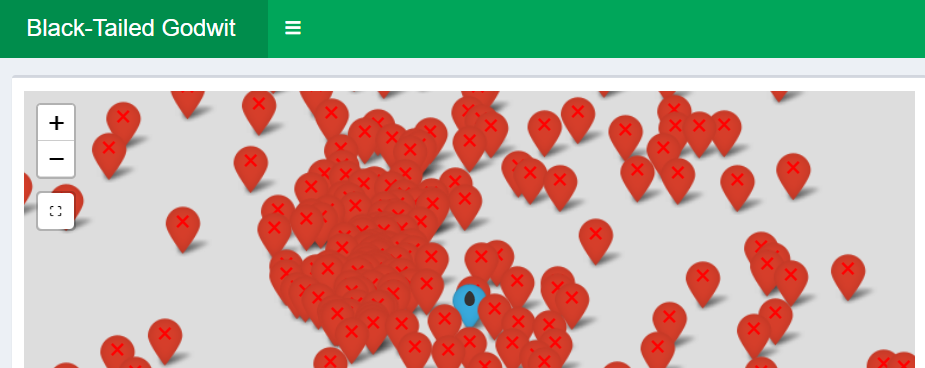
It was in Visualization Tools, I created the Shiny R application below. It utilizes a proxy dataset from one of godwit population and
one can select a number of points in several ways to create a filtered spreadsheet of points of interest. We used this tool to label a majority of our
points in my research with Dr. Senner. I hope to include a tool such as this when I finalize an R package for our new methodology. Dr. Senner and Luke have
mentored me in this research, but I have been mentored so much in other aspects by my professors and peers. I pass along this mentorship in my organization as
a National Fellowship Senior Peer Leader. Within this organization, I teach freshman and sophomores how to connect with fellow faculty and tell their stories about
who they are in their own fellowship applications. One of the important lessons that I carry to them that was instilled in me while at the Senner lab is that
you should not change a essay to someone you are not, but amplifies your passion, uniqueness, and significant goals.